


How has COVID-19 impacted our children?
The pandemic may feel like it’s “over” but the long term affects, especially on the mental health of our children, is something that continues to plague our communities and homes.


To support our children post pandemic, we need to first understand the various ways that COVID-19 has impacted their wellbeing, both mentally and socially.
What is the social development impact?
There have been signs of developmental lag in some children’s social skills. Remember that children have missed out on many normal developmental opportunities throughout the pandemic. Their social skills are out of practice and thus need extra care and attention.
DO: provide children with more coaching and be very explicit about how you want them to handle the challenges they run into.
DON’T: get frustrated with children for not always knowing the developmentally appropriate ways to interact.
DON’T: expect that children can figure it out on their own.
What is the mental health impact?
This stress will manifest in different ways for different children. Some children will feel sad, while others will feel anxious or even angry about what they've been through. It’s important not to confuse a child being in psychological distress with having a mental health problem. Feeling upset about the pandemic is a natural response for children to have. So if a child is tearful about all they've missed out on, this is normal as they feel comfortable to express their feelings through tears and are possibly even seeking consolation in an adult.
DO: expect your child to be more emotionally fragile than they would be normally be and be extra patient with them.
DO: help them put their feelings into words or even find other ways to express themselves, such as through art, and offering them comfort and empathy.
DO: acknowledge and validate your child’s emotions.
THREE warning signs that a child needs mental health support:
- If a child is unable to receive or find ways to help themselves feel better.
- If a child is doing things that are harmful to others or harmful to themselves.
- If a child’s sadness starts to interfere with their ability to enjoy anything or feel hopeful.
What is the academic impact?
School closures affected children both socially and academically. While widespread digitalisation did help mitigate education loss for most children, the poorest children suffered disproportionately, due to a lack of good home-learning environments and internet connection. In addition, the increase in unsupervised online internet usage increased issues around sexual exploitation and cyber-bullying. In South Africa, studies found that being out of school not only lead to learning loss but mental distress, exposure to violence and abuse, missed school-based meals and reduced development of social skills. This means that, in the longer-term, the skills needed to transition into working lives will be affected.
Find out how to support the #SAFEBACKTOSCHOOL movement.
Is regression on the rise?
What is regression?
Most children have a very strong urge to move forward and “progress” in their development. But learning new skills also requires children to step out of their comfort zones, which can be stressful. When that stress overwhelms the excitement or benefits of progressing, then regression, or at least regressive behaviours start showing up.


Why has COVID-19 caused regression in children?
The COVID-19 pandemic has caused a lot of stress on our children, disrupting their beloved routines like school and playdates, while isolating them from the world. This stress can cause regression: temporary steps back in development. And with consistency and predictability being more difficult to achieve during COVID-19, children are often prone to feeling anxious and frustrated, which can result in behavioural dysregulation.
What are the more common regressive behaviours?
- Unlearning skills that your child had formerly mastered, eg toilet training or sleeping.
- Difficulty managing their feelings of anger, sadness and anxiety.
- Using baby talk and other “childish” behaviours that are not age-appropriate
- Needing help with their usual routines.
- Temper tantrums in younger or even older children (include college students).
Eight ways to help your child get back on track
- Follow a daily schedule as much as you can.
- Offer more comfort. Since regression is a sign that children are struggling to cope, offering more snuggles, hugs, and other compassionate physical touches throughout the day can help calm and soothe them.
- Give children something to control – be it the choice of snacks or TV shows or a chore that they need to do as part of their daily routine.
- Help them make connections between what’s happening in their life and the world outside so they can better understand their feelings.
- Make sure your own stress and anxiety are in check, because your children will absorb that.
- Help your child find ways to regulate their emotions, eg going for a walk, running, deep breathing, drawing, painting.
- Find ways for your child to stay in touch with friends and family.
- Find ways to be together and do activities together, like reading or playing.
How can I help my child overcome bed wetting?
One common regressive behaviour with small children is bed wetting. Here are some ways to address it:
- Investigate whether there are changes at home or school that may be impacting this.
- Find out what is making your child feel anxious, so you can work to support them.
- If they are young, use a pull up/diaper for sleeping.
- Keep track of your child’s fluid intake and limit it before bed and then note how often the pull up/diaper is dry in the morning.
- Support your child to grow age-appropriate independence in other areas ( eg dressing and washing hands, eating, etc) helps build self-esteem that can help lead to mastering all aspects of toilet training.
Does my child suffer from anxiety?
Anxiety is one of the main long-term effects of COVID-19, especially in children. But anxiety can arise as a response to any stressful event or situation in a child’s life. So you need to be able to identify it so you can help them handle it when it arises.

FIVE signs your child could be suffering from anxiety:
- Shows reluctance to separate from parents
- Needs constant reassurance (Are we going to be okay? Is daddy going to be okay?)
- Shows persistent physical symptoms like headaches or stomach aches
- Has regular tantrums or meltdowns.
- Has trouble sleeping
How can I help my child manage their anxiety?
- Identify and remove stressors that trigger their anxiety. This will help them learn to tolerate their anxiety and function as well as they can, even when they’re anxious. As a by-product, the anxiety will decrease over time.
- Don’t avoid things just because they make a child anxious
Helping children avoid the things they are afraid of will make them feel better in the short term, but only reinforce their anxiety in the long run. - Express positive (but realistic) expectations
Instead of promising a child that they won’t ever fail at something, express confidence that they’re going to be okay because they will be able to manage it when it happens. This gives them confidence that your expectations are realistic, and that you’re not going to ask them to do something they can’t handle. - Don’t ask leading questions
Encourage your child to talk about their feelings, but always asl open-ended questions, like” “How are you feeling about the science fair?” instead of leading questions like “Are you anxious about the big test? In other words, don’t plant an emotion rather let them tell you how they are feeling. - Try to keep the anticipatory period short
When we’re afraid of something, the hardest time is really before we do it. So try to eliminate or reduce the anticipatory period by not focusing on it for days or hours before the event. - Plan to face fears with the child
o It can help to talk through what would happen if a child’s fear/s came true, eg if a parent didn’t come to pick them up from school. “If your mom doesn’t come at the end of soccer practice, what would you do? For some kids, having a plan can reduce the uncertainty in a healthy, effective way. - Try to model healthy ways of handling anxiety.There are multiple ways you can help kids handle anxiety by letting them see how you cope with stressful events and triggers. So instead of hiding your anxiety, let the child hear or see you managing it calmly, tolerating it, and feeling good about getting through it.
THREE Techniques to help your child regulate their emotional and physical responses:
- Deep “rainbow” breathing: Teaching your children to “breathe the rainbow” by taking slow deep breaths and thinking about their favourite things to match each colour helps them slow their heart rate and relax their muscles.
- Progressive muscle relaxation: Most kids tense their muscles when feeling anxious. Take them through a 2-step “tense and release” exercise to help them practice the art of relaxing.
1) Tense and hold a specific muscle group (eg: arms, hands or shoulders) for five seconds
2) release the muscle group and notice how you feel. - Create a relaxation kit:
Fill a box with relaxing activities that have been chosen by your child (eg music, colouring books, fidget toys, books, stuffed animals) and create a relaxation area somewhere in your home.
Want to learn more about anxiety?
Discover ways to identify, support and help your child manage anxiety.
Bullying
Bullying is a growing worldwide phenomenon that has a huge emotional, mental and physical impact on children. The problem with children is that their need to fit in is so strong that they don’t often recognise that they’re being bullied until it’s too late. But bullying is not something to ignore. If left unchecked, bullying can make a child feel scared, degraded and even worthless. Many children who are bullied even start asking themselves if they can do anything right.

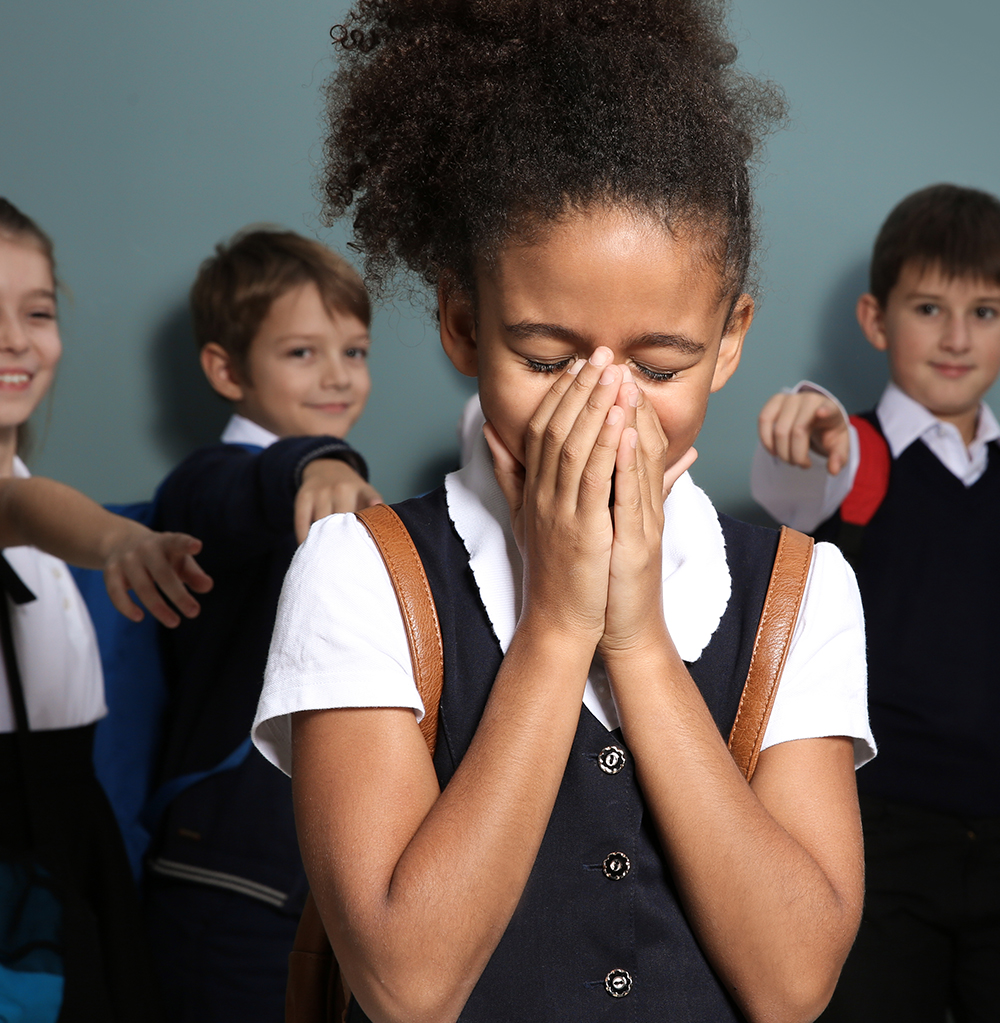
Help your child understand what “bullying” looks and sounds like:
- Name calling
- Making things up to get you into trouble
- Hitting, pinching, biting, pushing and shoving
- Taking things away from you
- Damaging your belongings
- Stealing your money
- Taking friends away from you
- Spreading rumours
- Threats and intimidation
What advice should I give my child around bullying?
- Bullies don’t like people to see what they are doing. Encourage your child to stay in safe areas of the school at break and lunchtime where there are plenty of other people
- If taking a school bus, encourage your child to sit near the driver or adults.
- If they have a cellphone tell them to be careful who they give their number to and to tell you if they receive any threatening phone calls or emails.
- If they see anyone else being bullied at school, encourage them to tell a teacher when there isn’t anyone else around and it’s safe to do so.
The rise of cyber bullying
With many children retreating online for all their school and social activities, COVID-19 created a huge rise in cyberbullying. The problem with cyber bullying is that, unlike 'traditional' bullying that usually takes place in one location (like the playground or at school) cyber and text bullying can happen, consistently, at any time of day and for days or weeks at a time.
Cyber bullying can happen:
- By using text/messenger apps/email
- Through social networking sites
- By setting up a site with the intention to 'victimise' an individual or group of people
- Through online gaming
Cyber bullying tactics includes:
- Having nasty comments posted about a photo
- Receiving a threatening or nasty message privately
- Having your profile wrongfully reported
- Being bullied in an online game
- Having your private information shared
- Having somebody impersonate you online
- Having rumours posted about you online
- Having photos/videos of you posted or shared that you don’t like
Get APP support
Help is in the palm of your hand
Ever heard of Chill Panda? It’s an App that helps children understand their stress and shows them ways to feel better using breathing techniques, yoga, exercise and calming games. And there are many more apps (some free) that have been developed and designed to help young people, adults and families with their mental health and wellbeing.
To support our children, it’s essential that we make sure every member of the family gets the help and support they need.
Here are a list of apps that can support the mental health of the entire family